Dawam al hal min al muhal—No Condition is Permanent

Art in Public Spaces <=> Social Sculptures
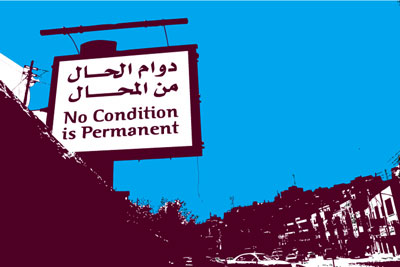
Project concept: Rayelle Niemann
Artists participating:
Egypt: Rana El Nemr and Mahmoud Khaled
Jordan: Hanan Khalil and Samah Hijawi
Lebanon: Pascal Hachem
Palestine: Fawzy Emrany
Switzerland: Jörg Köppl and Peter Zacek
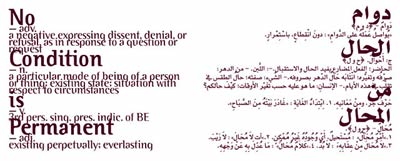
Cover design by Ala’ Diab, 2007
A state of living is based on developments continuously changing for the better. This ideology is deeply rooted in the psychology of human beings, having to believe in the positive, in the creative, in an organically growing order to improve life. Still, human beings are challenged to be flexible and innovative in order to react on changes regarding personal issues, social, economical, technological and political subjects. Individual experiences and conditionings have an influencing impact on these processes. Cultural and social heritage serves as a base. Imagination, humour as well as ingenuity serve as additional power and strength. The stimulus to react will always be based on the desire to improve a situation, or at least to come to terms with it.
Yet, for a lot of people it seems that conditions stay the same, embedded in a vivid circle of life. To which extent do individuals have an impact on their own situation and therefore, how do individuals influence their immediate surrounding?
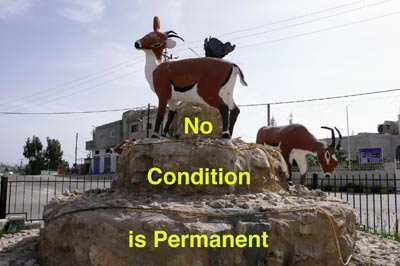
Photo/text work by Rayelle Niemann, 2007
The chosen site for the project, Amman, the capital of Jordan, refers to the situation in the region. Historically Jordan, the Hashemite Kingdome, always played a “neutral”, yet very distinctive role – it is the only country in the region where people from other Arab countries can enter without bigger difficulties. The huge numbers of Palestinians populating Jordan and now the growing numbers of Iraqi refugees have an impact on the social stratification.
Amman is well known and highly used as a hub for international and regional conferences, business as well as for family gatherings.
The countries of the Middle East region stand for economical and political insecurity, repression, and conflict.
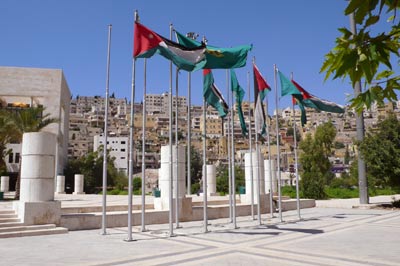
Amman City, photo by Rayelle Niemann, 2007
These are the set conditions, viewed quickly and superficially. How do historical and contemporary effects and preconceptions influence artistic strategies? Which impact can they have on cultural politics and on individuals?
During 4 weeks the artists conducted research on the situation of Jordan and the city of Amman, which was built on 7 hills like Rome, starting its modern history in 1878. In order to gain a deeper understanding of the complex situation in Jordan, historians, sociologists, urban planners and activists were invited to share their perspectives on Jordan with the artists involved in the project. At the Department for Art at the Jordan University the artists gave presentations of their works to students, teachers and professors.
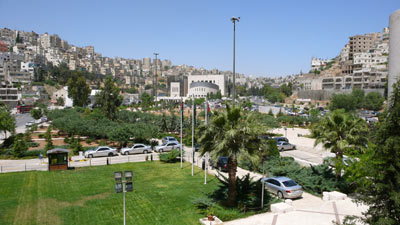
Amman City, photo by Rayelle Niemann, 2007
This Art in Public Space Project was a novelty for Amman. The very different medias applied, radio broadcasting, postcards, interventions, performances, advertisement made it possible to reach very different people in different contexts.
A Gazette opened up another public level – 1000 copies were distributed in various places and events in Amman, serving NOT as a documentation of the project, but additionally offering further statements and reflections.
Saba Innab, artist and architect in Amman, delivered a special contribution,
as well as Ala’ Diab, a graphic designer and sound artist, who also signs responsible for the graphic design and layout of the Gazette.
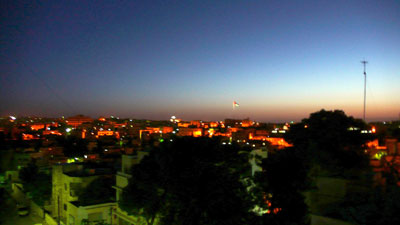
Amman City, photo by Rayelle Niemann, 2007
This project was made possible with the kind funding of:
Pro Helvetia, Swiss Arts Council
and the support of the Royal Film Commission, Jordan.
[ top ]
→ The Banquet
→ The Bench
→ Call for Job
→ Counting Years
→ The Dice
→ DIWAN
[ → more ]
RELATED WEB SITE
→ «Gazette» / PDF 3.9MB
[ Abou Naddara ]
[ Accessible Approach ]
[ Beyrouth ]
[ Cairo as Canvas ]
• Dawam al hal min al muhal—No Condition is Permanent •
[ De Montmorency à Metz ]
[ Dowry No ]
[ Fear of a Muslim Planet ]
[ Fragmented Letters ]
[ Gentle Wall project ]
[ Images and Images ]
[ Kafranbel ]
[ Leading a Smart Revolution ]
[ Lens of a young Person ]
[ Muraqabet amel jidariya—Watching the Creation of a Wall Painting ]
[ No Holy Cows ]
[ On Graphic Crimes and Visible Fractures ]
[ on going ]
[ PMS = Poster Message Service ]
[ Réconciliation ]
[ Rasael—Messages ]
[ Seipone ]
[ T.W.B.T.C ]
[ This is a picture book ]
[ Vitry ]
[ What remains and Things to come ]
FEATURED THEME ON CITY SHARING
by ASUNCION MOLINOS GORDO
-
This project is an instrument for common critical analysis to help understand the reasons behind Egyptians’ diminishing …
by INAS HALABI
-
The project Letters to Fritz and Paul focuses on the expeditions of the Swiss cousins, lovers and scientists, Fritz and …
by SARAH BURGER
-
The planned modern city of Brasilia attracted me since a long time. Her defined shape, location and function proceded he …
by ADRIEN GUILLET
-
Youri Telliug talks with the artist Adrien Guillet about his project Citracit
Youri Telliug - What is Citracit …
by NIGIST GOYTOM
-
In 2013 more than 45 million people have been forced to leave their homes. This amounts to the biggest number of refugees …
by SULAFA HIJAZI
-
The on going debate on Arab identity and its (cultural) representation is strongly shaped by Edward Saidʼs formative …
by ASUNCION MOLINOS GORDO
-
WAM is a site-specific work that uses the historical trope of the cabinet of curiosities to explore the introduction of …
MORE CONTRIBUTIONS BY THE FOLLOWING