Going for a Ride
Objects of desire, traces of European industrial and technological achievements here manifest themselves in Swedish icons: two car brands, Volvo and Saab.
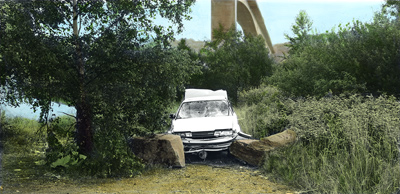
Angeredsbron, Göteborg, Sweden 2005
Found along the outskirts of contemporary cities, in the countryside; left, forgotten, showing signs of crucial fate, coated with a patina of time, the damaged cars no longer stand for lasting wealth and prosperity. They rather symbolically illustrate the fall of national virtues; morally – Saab’s engagement in weaponry, and economically – selling Volvo off to Ford.
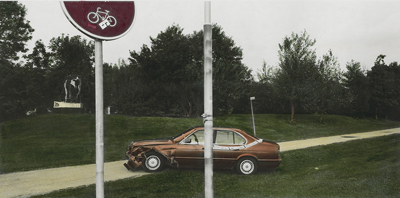
Gamla Uppsala, Sweden 2006
Nevertheless, these cars, not revealing their stories and memories, appear trivial along the roadsides. They become part of a landscape, temporarily or forever.
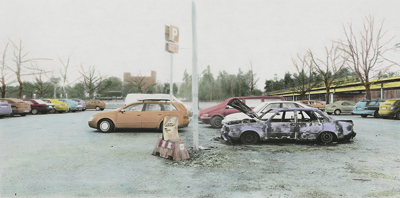
Gubbängen, Stockholm, Sweden 2007
In his work – cars in landscape - the Swedish art photographer Björn Larsson demonstrates in a first step, by taking black and white photography, the interlacing of nature and symbols of technological progress. He shows the penetration of two concepts, which were originally created as juxtaposition.
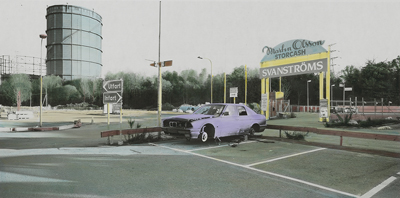
Hjorthagen, Stockholm, Sweden, 2006
Acknowledging the gradual engulfing of two mutually dependent spaces, once neatly kept side-by-side, consequentially he merges this binary, he offsets a dichotomy to present it as one space.
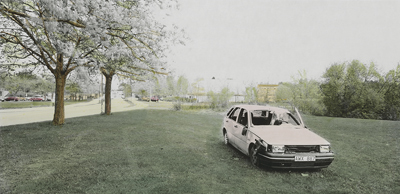
Hökarängen, Stockholm, Sweden 2006
With the raise of the industrialisation nature was reinvented. It changed its significance from a mare place of agriculture and unknown wildness to a place of leisure in order to escape human made places of production and living. The need to leave these growing cities, unhealthy effects accompanying new production possibilities, demanded a novel concept and appropriation of nature.
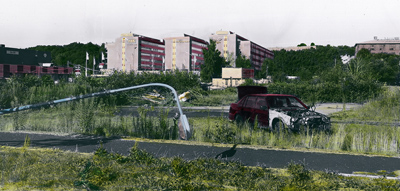
Kallebäck, Göteborg, Sweden 2005
More and more space, defined as the other, along the edges of culturalisation has become object of conquest by controlling through encroached shaping. Paths through forests, holiday houses along the shores, parks for amusement and lingering, landscapes were created and understood as beneficial exploitation of nature for the people. These actions were also perceived as a victory of mankind over a creation that finds its explanation in a divine presence.
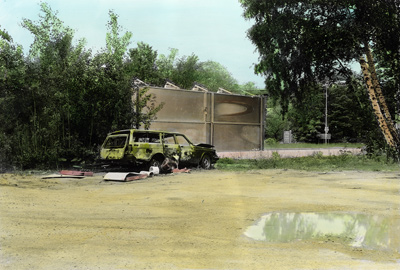
Karlberg, Stockholm, Sweden 2004
The idea, the imagination, the perception of nature changes constantly.
Yet, till today, the more alien something appears, the more it is perceived as something natural, as long as it can be dominated by technique. Nature became more and more a commodity, something people are able to afford, entailing a leisure industry.
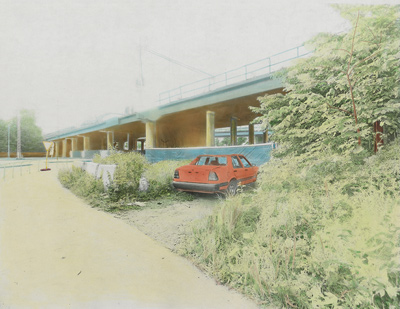
Norrtull, Stockholm, Sweden 2008
Along with industrial developments to produce more and more faster, cheaper products over the course of decades of industrialisation, cars have become a standard commodity for almost all people.
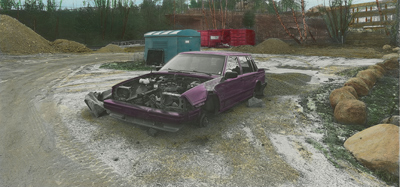
Ragsved, Stockholm, Sweden 2007
In a second step, Björn Larsson takes his black and white photographs of cars in landscape to Egypt, linking and approaching another industry: an industry for the image of remote otherness, created by “the others” and by the other “other”.
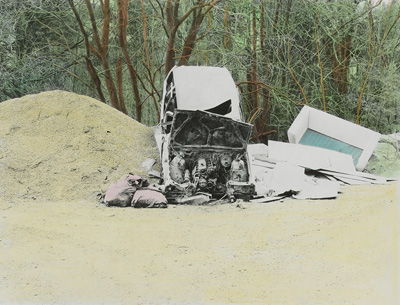
Skarpnäck, Stockholm, Sweden 2006
He reverses the flow of images into Europe, ushered by travelers fleeing European cities parallel to the industrialisation to escape increasing fumes, noise and crowdedness in search for adventure, untouched nature, authenticity - a canvas for their imagination.
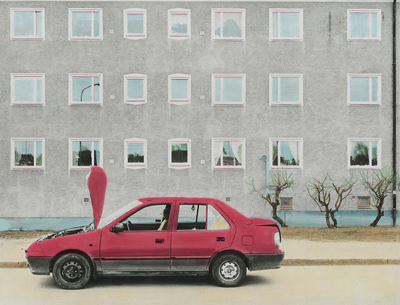
Sköndal, Stockholm, Sweden 2006
This huge image transfer was induced by the manifold artistic productions during and after these travels in the 19th century, from the East to the West, shaping an idea, convoyed by an understanding accordingly. The voyagers` luggage was filled with images, and writing, depicting people’s lives in unknown cultures.
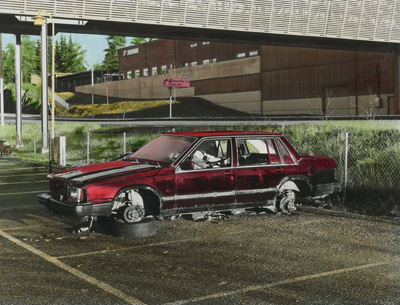
Södertälje, Sweden 2007
In addition to paintings, the development of transportable cameras allowed travelers then to collect visual trophies, taking pictures of their discoverings. Although the bulky instruments demanded long exposure, the memento mori was considered as a token of the ”real” life of ”the other ”, as a snapshot.
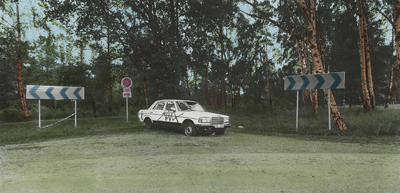
Stora Skugggan, Stockholm, Sweden 2007
Later, these black and white photographs were often colored to transport the atmosphere, the ambience conceived, emphasising on some certain elements and revealing presumptions. A whole industry was established, laying the foundation for an imagery, which is controversially discussed until today.
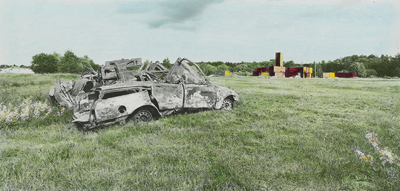
Tierp, Sweden 2006
During several project sojourns in Egypt, since 2002, Björn Larsson found himself confronted with the phenomena that he could not take pictures. Everything he has seen, was already taken. Consequently, he imported images from the place he comes from. The b/w photos were giving to Egyptian hand colorists to see how someone from another culture and with different references would translate the images from his triviality with the help of color.
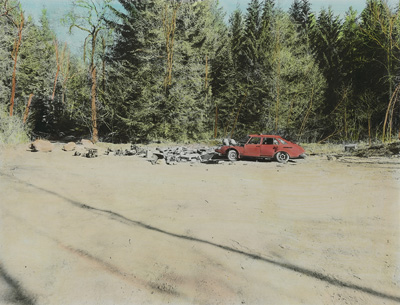
Tyresta, Sweden 2005
Without any guideline, local hand colorists, here Maha Kamel living in Cairo, impose their understanding, their perception, in color and light onto the b/w photographs, herewith completing the piece of art.
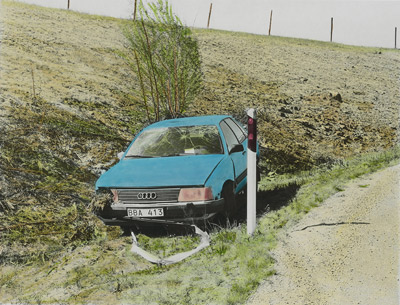
Vreta Kloster, Sweden 2006
Regarding the coloring as an act of translation, the photographer investigates the legibility, the understanding of an image - since it is firstly created and secondly conceived. On further reflection Björn Larsson indicates the influential importance of the translator.
photography by Björn Larsson, Sweden, 2005-2007
hand coloring by Maha Kamel, Cairo, Egypt 2005-2007
text by Rayelle Niemann, Cairo, June 2009
RELATED WEB SITE
→ web-site Björn Larsson
[ A Stroll through Cairo and Time ]
[ Capital Presents ]
[ cheek ]
[ Dispositions ]
[ Drivers’ comment ]
[ E’laan—Call for Job ]
• Going for a Ride •
[ Of Huts and Tents ]
FEATURED THEME ON CITY SHARING
by ASUNCION MOLINOS GORDO
-
This project is an instrument for common critical analysis to help understand the reasons behind Egyptians’ diminishing …
by INAS HALABI
-
The project Letters to Fritz and Paul focuses on the expeditions of the Swiss cousins, lovers and scientists, Fritz and …
by SARAH BURGER
-
The planned modern city of Brasilia attracted me since a long time. Her defined shape, location and function proceded he …
by ADRIEN GUILLET
-
Youri Telliug talks with the artist Adrien Guillet about his project Citracit
Youri Telliug - What is Citracit …
by NIGIST GOYTOM
-
In 2013 more than 45 million people have been forced to leave their homes. This amounts to the biggest number of refugees …
by SULAFA HIJAZI
-
The on going debate on Arab identity and its (cultural) representation is strongly shaped by Edward Saidʼs formative …
by ASUNCION MOLINOS GORDO
-
WAM is a site-specific work that uses the historical trope of the cabinet of curiosities to explore the introduction of …
MORE CONTRIBUTIONS BY THE FOLLOWING